

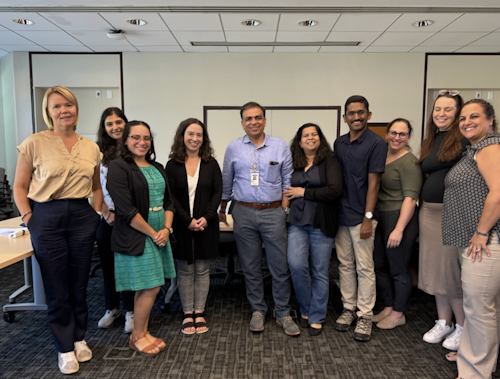
Emerging research implicates gait dysfunction as a preclinical marker of Alzheimer’s disease and related dementias. As part of a new NIH-funded project (R01AG089096) led by Dr. Joe Verghese — Chair of Neurology at the Renaissance School of Medicine — the team will assess gait by comparing “super-movers” to usual- and slow-movers.
To advance the field of gait and cognition in older adults, investigators will employ innovative gait phenotyping and multidisciplinary team science approaches to discover novel risk and protective mechanisms for gait dysfunction in the context of dementias.
About the Program
To successfully commence this project, the Division of Cognitive & Sensorimotor Aging (DCSA) (a research division within Neurology directed by Dr. Jeannette R. Mahoney) partnered with the Office of Clinical Trials to conduct this work within the new Clinical Trials Unit (CTU) in Commack, NY. Additional DCSA faculty contributors include Drs. Helena Blumen, Anne Felicia Ambrose, Nunez, Cotton-Koorathota, Nadkarni, Pollak, and Ms. Ayers.
State-of-the-Art Facility and Methods
The team has created a state-of-the-art research facility housed within the Commack CTU that contains a 30-foot quantitative gait mat (in the shape of a track). Quantitative gait is measured as participants walk at their normal pace. During walking, researchers also assess electrophysiological brain activity in response to both normal walking and walking while responding to uni- and multi-sensory targets.
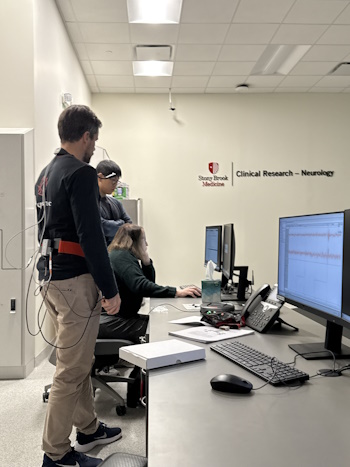
- Eye-tracking goggles to capture pupillometry indices and a “bird’s-eye view” of the participant’s scene during testing
- Inertial Measurement Units (IMUs) worn on the lower back to track orientation, navigation, and angular velocity
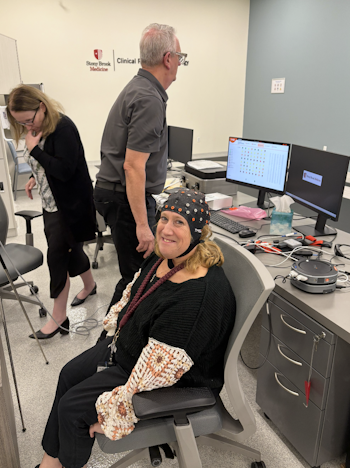
- EEG to measure electrophysiological brain activity during walking and dual-task conditions
Timeline and Collaboration
The SuperMovers project is anticipated to begin enrolling and seeing older adults as early as March. The team is eager to collaborate — investigators interested in partnering are welcome to reach out.
Learn more about the research program and faculties: Department of Neurology – Renaissance School of Medicine
Photos
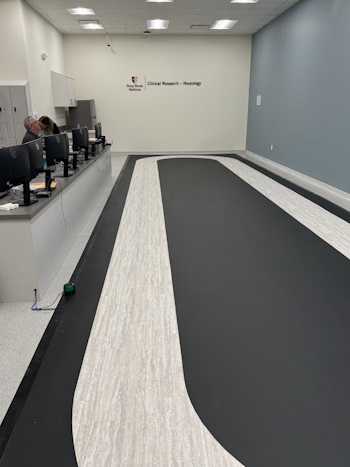
Commack CTU gait research space featuring a quantitative gait mat.
EEG setup used during walking assessments at Commack CTU.
Equipment used for gait and cognition research (eye tracking, EEG, IMU systems).
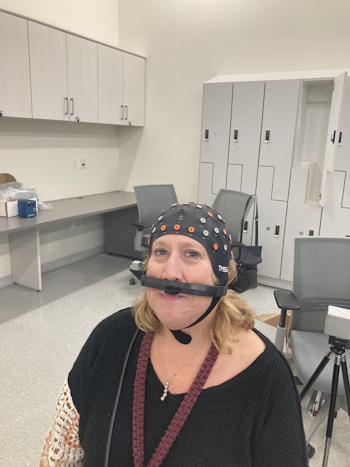
Eye tracking, EEG, and IMU systems used in the SuperMovers project.